Grand Kenyan Roadtrip - Part 3 The North

Updated: Dec 12, 2025
Day 13 - April 12
Mt Kenya played a central role on my first trip to Kenya. Partaking in an enthralling and genuinely gruelling 4-day hike, Melissa, Tim, myself, Apollo, Jack, and our mountain guides made it to the near summit of the mountain; Point Lenana, 5000 meters above sea level. That deserves its own narrative, but for now, you have to be content with a recounting of this trip's visit to the great mountain. Fresh off our Mara exploits, we slept in, happy to dry our gear and repack and rejig the Nissan. It was already mid-afternoon when we arrived at the mountain, driving up through the cloud forest to Castle Lodge. An absolute gem of a place, it is rustic but well kept, with cheap camping or affordable lodgings, hearty fare at the restaurant, and the best place in the world to spot Olive Ibis.

On our way up, we pulled off at a river crossing, noting a flurry of activity amongst the trees. Birding a cloud forest is definitely a vibe. Whether in Kenya or Ecuador, it feels the same. Towering trees shrouded in mist with bamboo and dense shrubbery lining dirt roads that snake up a mountainside. Mixed flocks roam here and there, with a solitary songster belting out from dense shrubbery, always careful to avoid the gaze of the eager birder. Today's vibe was comforting and familiar, though the avian cast had some new members. A pair of Black-fronted Bushshrikes working some tangled vines kept my daily lifer streak going, and a Purple-throated Cuckooshrike in the treetops had our spirits leaping to those heights. Some familiar faces from 2022 popped up, the endearing White-bellied Tit, Kikuyu White-eyes here and there, Chestnut-throated and Grey Apalis in the tangles, and a group of vocal Hunter's Cisticolas.

Arriving at Castle Lodge, we pitched our tent on the lawn, and began our vigil for the Olive Ibis. As evening falls, these retiring forest-dwelling Ibis retreat up the mountain to roost deep in the forest. Lucky birders can keep their eyes and ears peeled to catch these amazing birds flying overhead, their raucous cries belying their presence long before their forms are visible in the evening sky. As we watched and listened, we scoped a Waller's Starling, and a flock of Scarce Swifts zipped by. As the evening lengthened, it seemed apparent the Ibis were elsewhere. No sweat, we would try and catch the birds at first light descending back down the mountain. While watching and waiting, two different birding groups arrived that evening, and as is de rigeur in these situations, we socialized that evening. We exchanged a few stories, but mostly listened to an eager yank wax poetic about rails (the bird kind), his main work focus and clearly his singular passion in life. For his wife's sake, I hope he brings some of that passion to their marital life.
Day 14 - April 13
We would not let the sun outpace us this morning as we did not want to miss our chance at the Ibis. As the soft morning light filled the world, we heard the far carrying cries that awaken the mind and body better than the best Italian espresso. To our joy, two Ibis flew overhead and perched atop a tree—a temporary pause on their morning journey down the mountain. Scope poised, it wasn't long before the other birders joined in the fun. Watching the ibis, I made a silent affirmation about how special a moment it was to be perched high on the mountain side surrounded by beautiful cloud forest, catching a brief moment in the intricate and mysterious life of these unique birds—be present and don't take this moment for granted!

For the rest of the morning, Tim and I, along with a guide from the lodge, enjoyed some top-notch birding. We spied the Abyssinian Ground-Thrush, Abyssinian Crimsonwing, and heard a most elusive of bird, the Buff-spotted Flufftail. Had we seen the flufftail, my mind would have been so blown, I'd still be rearranging the neurons. Joining up with the other birders, we slipped through the forest in search of the Orange Ground-Thrush. The fantastic Bar-tailed Trogon made an appearance, but it was not until we set off on our own that we saw the thrush. C'est la vie! Riding high from an excellent morning, we left the confines of Mt. Kenya, with our sights set on the neighbouring Aberdare Mountains.

On route to the mountains, we made a quick pharmacy stop. Things were starting to head a bit south for me, and I convinced the clerk to dispense the necessary meds without time wasted seeing the doc. I don't necessarily recommend this approach, but in my case, I knew what was needed and hardly any time was wasted. Before long we were approaching the mountains. As we entered the park and worked our way up the slopes, a dazzling display of Eurasian Hobbies catching flying termites unfolded over grazed patches of land. Climbing higher and higher, it felt like we were the only people in this whole section of the park. Indeed, when we made it to the small ranger station, they were surprised to see us, though very accommodating nonetheless. Camped in the grass next to their hut, we enjoyed a nice campfire in the cold mountain air before the drizzle eventually sent us to our tent and a well earned night's rest.
Day 15 - April 14
Today's plan was once again highly ambitious. Like I said, Tim's climbing urge was only partly satiated by the Devil's Tower at Hell's Gate. High in the moorland of the Aberdares lie the Dragon's Teeth. This cluster of rock spires temps the hardcore climbers, and many trad routes have been established up their jumbled sides. However, most normal folk are content to do the challenging hike. Heck, most birders are content to simply drive to the trailhead and poke around for some high elevation specialties. Not Tim. Festooned with heavy climbing gear, we set off to the Dragon's Teeth to combine both climbing and birding at 4000 meters above sea level.
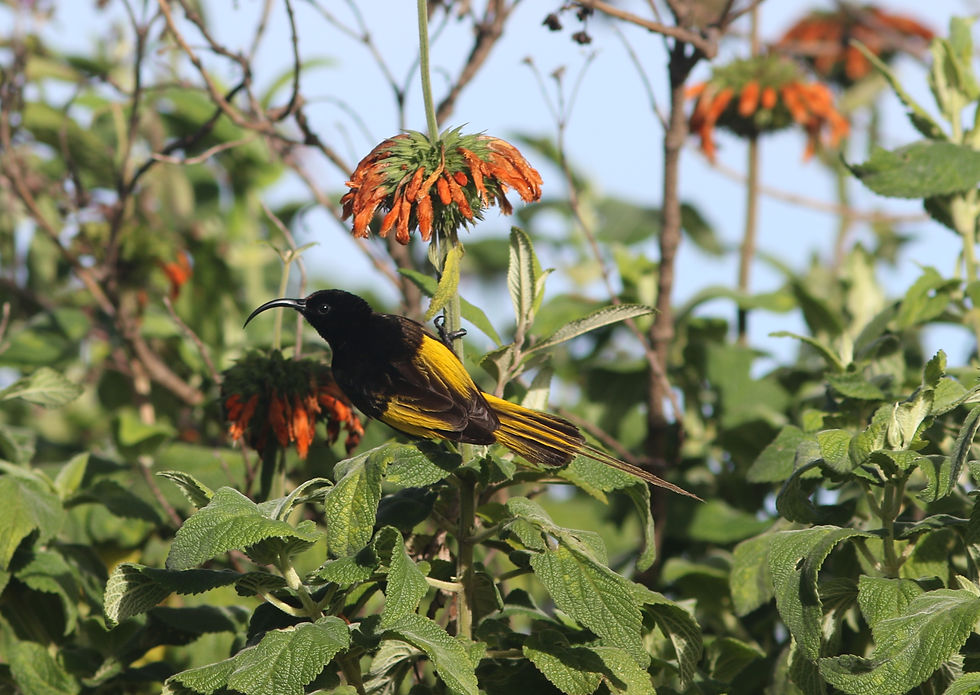
As we setoff, I was reacquainted with some old avian friends from my 2022 Mt. Kenya trip. The ubiquitous Moorland Chat, and the stunning Red-tufted Sunbird. New for me were the equally alluring Malachite Sunbird and Golden-winged Sunbird; as fine a sunbird trio as any. Amongst the more open grassland, we spied a number of the endemic Aberdare Cisticola, a primary target. The ecologist in me is baffled as to why this species is found in the moorlands of the Aberdares but not those of the neighbouring Mt. Kenya, but for now, I have no choice but to accept this mystery.
As the trail wound upwards, we came upon a sloping wet meadow that was rumoured to occasionally host Striped Flufftail. If my mind would have been blown by seeing the Buff-spotted Flufftail, my whole essence would have vaporized and ascended to the heavens had we seen this enigmatic bird. Given I am now recounting the story, you rightly guess that we did not detect even the slightest peep or murmur of it. As the hike continued through the moorlands and approached the teeth, I must admit, they did look rather enticing from a climbing perspective. Setting about at their base, Tim attempted to locate some of the routes he had done on his first and only visit with a local climber. Struggling, we scrambled to the top of some of the teeth via a gentler back route. Try as we may, Tim couldn't get a good read on the routes. Not wanting to attempt ill fate, we scrambled back down, took off our harnesses, and refocussed our minds to the birds of the surrounding moorland.
While we had been debating atop the teeth, we imagined the distant cry of a francolin. If we both imagined it, it must have been true. Weaving amongst the tussocks to where we thought the call had originated, we left empty-handed knowing full well that the call had surely been that of the highly localized and rare Elgon Francolin.
Back at the car, exhausted and a bit light headed, we needed some emergency sustenance. Boiling up some eggs, the endemic but locally common Jackson's Spurfowl came to inquire at the day's fare. Accepting the offering of egg and bread, I remarked that I hadn't anticipated feeding so many highly localized and globally rare species on this trip!

Eggs consumed, we were off to the town of Naro Moru while continuing to perfect our duet of 'I'm Just Ken'. If you haven't seen the Barbie movie, go see it. It is a poignant yet hilarious take on our society. While lost in thought, Tim pulled off the highway unannounced. It finally dawned on me that the quarry beside where we had just stopped was none other than Kiawara, the go-to spot for Cape Eagle-Owl. Scanning the far side of the quarry, we could not locate any roosting owls, their whitewash the only indication of their presence. Undeterred, we scrambled down into the quarry to ask the local cultivators about the owl. Happy to help, they led us directly under the cliff where the striking owl sat roosting mere meters above our head. Repaying their kindness with a free ride into the local market, we did however pay a small price: nasty welts on our legs. Mixed in with the crops were many nettles of a most vicious kind, and mere hiking pants were no protection.

Arriving in Naro Moru to we pick up Jackson, fresh off the mountain and ready to join our birding trip, we continued on to Nanyuki for the night. With the sun long set, it was with a very weary body and mind that I fell asleep at the hotel knowing that tomorrow would be THE day of the trip.
Day 16 - April 15
As hinted above, today was long circled in my calendar. From the initial planning phase, I hoped today would be the day I would see the rare Masked and William's Larks. To top it off, we were adding another attempt at Elgon Francolin. Could we really see all three in one day? That would almost certainly be a birding first.
Relishing the day's potential, we headed for the nearby lower slopes of Mt. Kenya. Here, on a sprawling farming and ranching estate the size of most counties, the francolin had been spotted at lower elevations than their typical high elevation moorland haunts. Recently some birders had been allowed access, and we hoped the same grace would be bestowed upon us. To make a convoluted story short, we were unable to gain access in large part because the owner was out in his private plane doing rich landowner stuff. With half the morning spent dicking around, we threw in the white flag. At least I had amazing looks at a Red-throated Wryneck. Wrynecks, funky weird members of the woodpecker family, are a must on every birders life list.

As we turned off the highway further north in Isiolo, I was in new territory. Common roadside birds were lifers, but there was little time to stop as the allure of the rare larks beckoned,. After two painful hours being jolted up and down on a road that would eventually take you to Somalia, we had arrived. Bordering the well known Shaba National Reserve to the south, Nyambene National Reserve is a little explored gem. Here, recent rains had greened the dry barren landscape, heralding a short time of plenty for the birds, including the elusive Masked Lark. Not reliable anywhere except a few far flung spots in Ethiopia, the new life had drawn them to the reserve for a short breeding window. With a focal area in mind thanks to some intel from other birders, we parked the x-trail, minds ripe with anticipation. As we were setting, to our dismay a a large military convoy approached. Passing by, a few soldiers taunted us, much to Jack's chagrin. After they passed, it wasn't long before we heard the rattle of their mounted machine gun ringing from the hills. Our spirits were dimmed. Were bandits about? Would we be forced to leave? Thankfully, we didn't have to wait long for those answers, as the convoy was already on the way back, this time leading a herd of cattle. As they passed, we got a brief explanation. A kid had stolen a herd of cattle as part of an initiation ritual, and they were simply retrieving the stolen beasts, the machine gun firing just for show. Phew! As the convoy left us and the plains in peace, I felt a profound and sweeping sense of relief.
As a society we throw around superlatives rather liberally. We (myself included) infuse our social media posts and recountings of our lives with words like epic and awesome, when let's face it, most of the time it is just a step-up from mundane. Fanning out across the plains in search of the larks, I know most humans would find it only mildly invigorating, but for me, it was truly sublime! From the emotional low of the convoy encounter, to now feeling unencumbered by all except finding these rare and enigmatic birds, I was on cloud nine.
Careful not to trip over the lava rocks littering the ground and now mostly hidden by new greenery, we came across a dirt track with some small puddles. As Tim opened his mouth, I understood before any words were formed, he had found them! To my deep and everlasting delight, four Masked Larks were poking around the dirt, only mildly skittish of our presence as we danced around the puddles. Trying to get closer without flushing the birds, we settled on the ground and waited for them to circle back. Awkwardly crouched, I managed some photos of a bird panting under the shade of a small herbaceous plant, and then in an instant, the moment was gone. The birds flew and we were left alone in the dirt, the afternoon sun grinning down, unbothered by the birding exploits of three unimportant beings.

Eager to explore more, and still wondering what secrets the plains held, we wandered further afield, and then to my shock, we starting flushing more Masked Larks. Three here, four there, I could not believe it. Already to the point of bursting, we then flushed up the William's Lark. More range restricted than the Masked Lark but more reliably found in this region of Kenya, it was all I could do not to keel over right there to rest forever among the lava rocks spewed from the fiery depths of the earth.


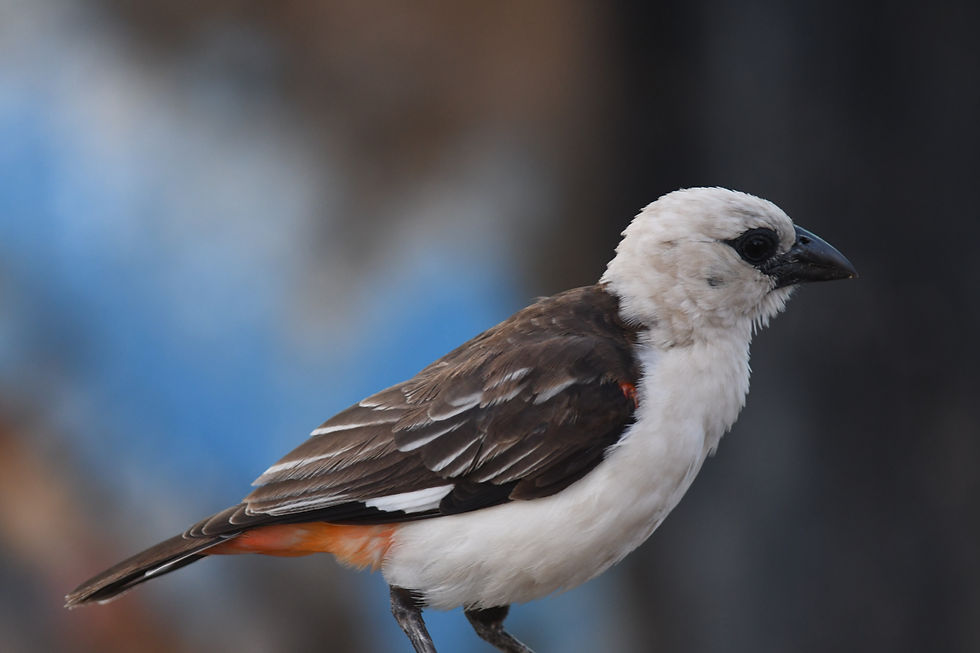
Starting to come down from the lark madness, I was ready to take in what ever else the day offered. Trying not to be outdone, we played hide-and-seek with the splendid Lichtenstein's Sandgrouse, a lifer and one that captured my awe as a teen while looking through the myriad forms of the world's birds. A migratory Great Spotted Cuckoo darted by, as did a handsome Capped Wheatear. Rosy-patched Bushshrikes sang despite it being mid-afternoon, and I spotted both the sharp looking Green-winged Pytilia, and its nest parasitizing pursuer, the ridiculously adorned Eastern Paradies-Whydah. It was already 4:30 pm when we accepted the day had run its course, and it was time to start the long drive to the small hamlet of Archer's Post, a good jump off point to explore the classic trio of National Reserves: Buffalo Springs, Shaba, and Samburu.
Day 17 - April 16
When we arrived at our hotel in Archer's Post the night before, I knew that our birding at Nyambene would not easily be topped, and I was content with that thought. Birding days a quarter as exciting would still be special. With that in mind, it was up at first light and on to Buffalo Springs, a short drive away. As we skirted around acacias looking for the Somali Bee-eater, I couldn't help but note the birding rage among my companions was more subdued this morning. Nonetheless, another fine day was brewing as I laid eyes on my first ever Oryx, and some persistence paid off when we found a pair of Somali Coursers. We had lots of Black-faced Sandgrouse, and a pair of Chestnut-bellied Sandgrouse.


Heading to the natural spring that gives the park its namesake, the enticing clear waters of this natural swimming hole drew us in, and before long, we were swimming, splashing, and lounging around. We needed a birding break, and in a blink, two hours flashed by. In that time, some families had come and gone, and so to had the birding group we saw on the coast, and again at Castle Lodge. We had sent them on their way armed with the courser location, and we eventually left for the nearby Shaba NR armed with hope at finding the bee-eater. Despite our lengthy stay at he pool, we had still seen 93 species and the day wasn't over yet.

Driving in to Shaba, we scanned every acacia for the bee-eater, but all we could spot was the common but still impressive White-throated Bee-eater. A herd of Grevy's Zebras turned our heads, and a stallion was none to pleased by our presence. As the road became gnarlier and gnarlier and our spirits sagging from the fatigue of a long trip, we gave up the bee-eater hunt.

By the time we made it back to Archer's Post, it was getting close to nightfall and we still needed to get to Samburu and find our campsite by the river. Entering proved easy enough, though finding the public campsite along the river proved a bit of a challenge; many tracks weaved off the main road. Finally finding the correct one, it was all we could do to set up camp before it was well and truly dark. Here by the Ewaso Ngiro river that separates Samburu from Buffalo Springs, we were once again camped with nothing but some large logs, our car, and nylon tent fabric for protection. At least this camp is fairly close to a number of camp-style resorts, and their wardens routinely walk along the river, keeping an experienced eye on things. The fresh night air was also very soothing after the airless concrete box of the hotel in Archer's Post, though that was a mere unpleasantry compared to the oven in Marafa!
Day 18 - April 17
Today was a full day to discover the comings and goings of Samburu. This game reserve, notably profiled in "Born Free', leaves the riverbank with large palm trees and extends into a countryside clad in dry grassland and thorny shrubbery. This morning's mission was simple, find a Somali Crombec. While the land held many lifers for me, this was Tim's one would-be lifer, and he was appropriately amped. As we weaved around the countryside, there seemed to be a dik-dik around every turn. A favourite animal of mine as a kid, the real-life version did not disappoint!

Arriving on the grounds of the Sopa Lodge, a known haunt of the crombec, we checked-in with the front desk and set about for this small unassuming bird. As we strolled around, we scanned the acacias intently for any crombec-like movement. It was then that we heard many shouts and noted the lodge guards striding forward, intent on informing us of some transgression we had unwittingly committed. In short, we had crossed a magical line and were now in danger and needed an escort. Not keen to engage in the illogic of letting us camp in the wilderness, but needing an escort to search for a crombec, I didn't argue. On the other hand, Tim was having a harder time letting the mental incongruence of the situation slide. "Somali Crombec, Tim, Somali Crombec, we are here for the Somali Crombec", I uttered. This mantra eventually worked, and we were back to the bird quest. On a side note, I respect the lodge having strict boundary rules for guests, I just like an honest conversation about it, not some fairytale of leopards braving the blazing sun and 32 degree heat in hopes of catching a juicy tourist unawares.

From the protective cover of the car, we hit the dusty paths to continue our search. Finally our persistence paid off and the crombec was in our sights. As it sat pretty, preening and scratching its chin in a roadside acacia, the satisfaction of the crombec washed over Tim. This was one of the last of his anticipated lifers, and called for a celebratory swim at Sopa's pool, and a drink or two at the bar. Lounging around the pool in the heat of the day, there was still some bird activity to be admired, if chatting with the bar staff or accidently splashing snooty tourists wasn't to our fancy. A nice flock of swifts buzzing overhead had Common, Mottled, and Alpine in the mix, to go along with the ubiquitous Little Swifts. At some point Tim disappeared, finally reemerging an hour later following a crombec inspired grooming—he had shed his mighty beard. It would take me a few days to get used to his new baby-faced look.

Back at camp, we made some supper, and then headed out for the obligatory evening game drive. Big cats were not on the viewing list this evening, but the steady stream of dik-diks, gerenuks, zebras, giraffes, and elephants was more than enough. Settled back at our camp for the evening, I turned my attention to the bookkeeping side of birding. The trip was winding down, and I was refreshing myself on what targets remained, especially in Samburu. With a list of targets running through my head, my eyes closed after another classic African safari day!


Day 19 - April 18
As we set about packing up camp by the banks of the river, we heard a great tumult. Mesmerized, we observed a huge herd of elephants passing along the far bank of the river. Stomping, crashing, and blaring their horns, they swept by, going off to do elephant things in an elephant world while the day was still young and the sun low in the sky. I must say, it was a good thing they were not on our side of the river!
As the last peg was packed, I was sad to leave this idyllic camp, but the target list was once again playing in my head, and it was time to go. Our morning's exit from the park was intentionally slow and winding, taking many side paths and loops hoping to spot the Somali Bee-eater, a rather diminutive member of this spectacular family. While we searched for the bee-eater, we'd surely come across the more common Red-fronted Prinia and Three-streaked Tchagra. I also held out hope for something even more wild, like a Serval or a Caracal. These two cats were some of the first animals I learned about as a kid, and long have I yearned to see them first hand. Try as we may, we couldn't find the bee-eater or any large cats, though we did find another Somali Crombec. As the last 100 meters of path rolled by before the exit, we did luck into a stunning male Fire-fronted Bishop doing its incredible bumblebee-like flight display, yellow rump ablaze in perfect bumblebee mimicry.


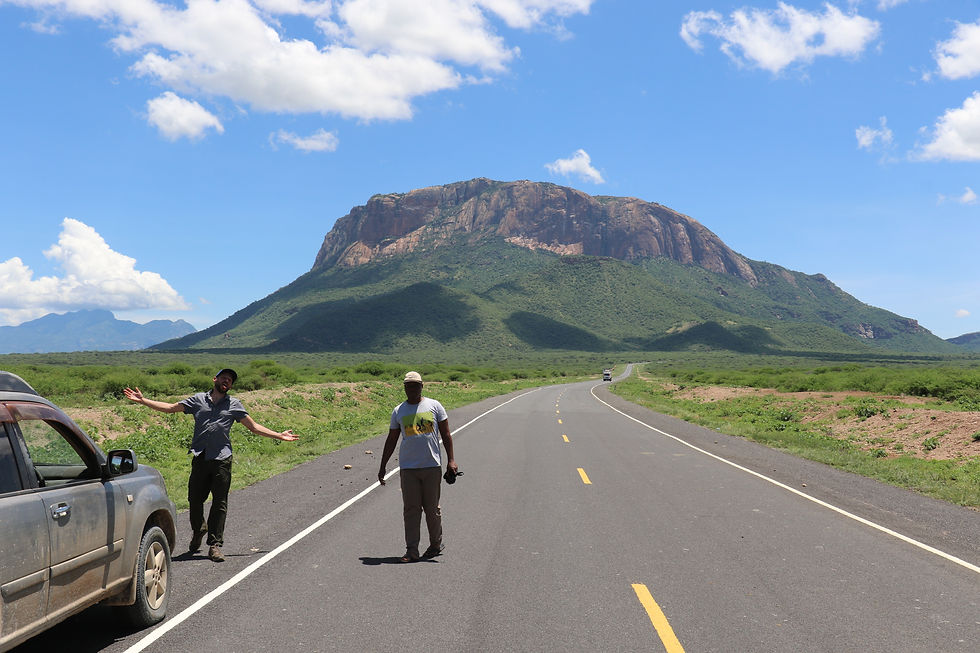
The bishop sighting renewed our spirits for the next leg of our journey. Here, we deviated from the classic birding tour route and went further north to Mt. Ololokwe. Rising up from the desert, this great plateau of a mountain is sacred to the Samburu, and a well known hiking destination for the non-birder. The surrounding countryside is part of the Namunyak Conservancy and there is a nice little camp at the base of the mountain to stay and get a hot meal. So, were we here to hike or to bird? Like usual, for both, though mostly for the hike. Tim insisted we not miss this iconic spot, despite the fact that he had been there on at least 2 previous occasions! Zipping along the blacktop with the mountain in sight, Tim truly surprised me by insisting we get out and take a picture. Not just any picture, but an insta famous one; the subject poses on the road and it continues behind you in a straight line to the mountain as the breathtaking backdrop. I guess even the plebes get it right once in a while 😜

It wasn't long before we had paid, arranged our guide for the following morning, and had our camp set up amongst the tall acacias nestled in a small valley at the base of the mountain. I even saw two Verreaux's Eagles soaring along the cliff edge while setting up the tent! As the day waned, our thoughts turned to owling. With dark fully setting in, we strode along the road with hopes of spotting a Northern White-faced Owl. Before long, we were hearing African Scops-Owls, Freckled Nightjars, Pearl-spotted Owlet, and a Verreaux's Eagle-Owl. Eagerly ploughing ahead, our ears picked up the cry of the white-faced owl, and soon it was illuminated by Tim's very awesome, and very expensive headlamp! Jack inexplicably tarried, so I sprinted back in he dark to usher him along. Not a bird to be missed. Presumably my dashing gait was not prey-like enough to attract any leopards on the prowl, and the three of us enjoyed the owls company for quite some time. Those that know my birding habits will know that I am not one for nocturnal birding. However, if all owling was like this, you can sign me up any day, even with an impending 4:30 wake-up call!

Day 20 - April 19
4:30 came early, and still bleary eyed and half asleep, we rose and walked to meet our guide. As we set out up the mountain in the dark, it was steep but none too challenging. With no heavy packs, and at only 2000 meters, it was no Mt. Kenya. As the sun rose, the birds started to draw our attention. A main avian target on the hike is the Stone Partridge. This gregarious small crested partridge is a bird of the Sahel region of Africa, with the northern part of Kenya the most eastern part of its range. Despite its raucous calls and gregarious nature, they can be very weary of humans, and early morning is the best time to catch a glimpse of them scurrying about the mountain side. Not long after sunrise, we practically ran into a roving band. They were quick to scatter, but not before I enjoyed decent looks.
Like the sun, we rose higher and higher until we hit a series of plateaus and then at last the near summit. From here, one stands at the top of a cliff and overlooks the wide lands all about; distant mountains rising up from the acacia-clad desert below. With a view on the wide world below, you understand the sacred nature of the place, and gain perspective on how one fits as part of the whole. While I was deep in thought, Tim had strayed. With a great effort, I roused my mind and body and followed Tim who had gone in search of the trad climbing routes to the summit. I found him scrambling about in a shrub clad gully, also deep in thought contemplating his next visit to the mountain to climb to the very top! Returning to the lookoff, we spotted a Stripe-breasted Seedeater, the last of Tim's target lifers. Not the most striking of birds, it probably takes a fairly serious connoisseur to get as amped as we were. Between that and the crombec, it isn't all about shiny things!


Ever ones to pack more than enough into a day, we planned to make Meru NP by evening, so we promptly hoofed it back down the mountain. I would like to say a smooth exit followed, but misfortune struck with a car mishap. Like most car mishaps, it is usually a series of irregular events that lead to downfall. Ours started with me moving the car into a tight corner after Tim had parked it in a perfectly reasonable spot. I did this so that a camp worker could fill the tires with some needed air, and also to keep it out of the blazing sun though the hardly matters now. Secondly, Tim hopped into the driver's seat after our long hike, and third, I had pulled in and then backed up, going around a stout sapling which was now in the back corner of the car on the opposite side of the driver. As Tim started backing out at a snail's pace, the last nail in the coffin revealed itself. The tree was perfectly in the small blind spot, and a fraction offset from the car, so instead of simply hitting it lightly with the rear bumper, the car squeezed by the trunk only for the back door handle and door panel to get crunched. Not a pretty sight, especially watching it in slow motion. Taking stock of the damage, the now handle-less door did stayed latched, so we powered on while wondering what the repair bill would look like in the end.
Still reeling from the mishap, we were suddenly back in Isiolo. Trying to shorten our route, we hung a left to head towards Meru NP on what appeared to be a passable road—cars were coming from that direction and Google seemed ok with the choice. I know I said we took rough roads on this trip, but those were mostly tracks, paths, or park roads. This one was 'paved', but was now a shell of its former self. For 30 kms, we painfully skirted, dipped, rocked, and plowed through crater after crater. Each heaping chunk of asphalt marooned in the road was harder, and each pothole deeper and wider, than the last. Making it to the hamlet of Muthara where we rejoined the main route was pure relief. I was miserable from the horrendous drive and the smashed car. Thankfully, things were soon to improve. First, Tim's friend Adrian was joining for the last weekend of our whole journey. A top notch birder and adventure companion, the mood improved immediately upon finding him among the hustle and bustle of the main intersection. Second, we restocked our larder, going heavy on the fruits. And when I say heavy, I mean the car ended up looking like an overflowing orchard. As a fruit fiend, I approved.

As stories were exchanged among us old campaigners, and Adrian had some doozies, I felt reborn. At the park gate, while Tim gave a lengthy diatribe to the park clerk about the objectionable nature of hidden fees of which he had just been informed, Adrian finally got me a visual of a Pearl-spotted Owlet. We had heard many on our trip, but it was almost inconceivable to think I hadn't seen one yet, especially considering I had seen Marsh Owl, African Scops-Owl, Sokoke Scops-Owl, African Barred Owlet, Greyish Eagle-Owl, Cape Eagle-Owl, Northern White-faced Owl, and African Wood-Owl already. Adrian was practically dumbstruck, and even more so when I told him we missed Red-fronted Prinia and Three-streaked Tchagra between Samburu/Buffalo Springs/Shaba, but had seen not one but two Somali Crombecs. Don't you just love little birding idiosyncrasies?
Finally resigned to the clerk's indifference to hidden fees, Tim took our passes and left the man in peace. As the new terrain whipped by, Jack, Adrian, and I did our best to jam our bodies out of the sunroof with some modicum of comfort. The road was packed with Yellow-necked Spurfowl, and the grass teemed with thousands of Chestnut Weavers. We were beelining it to a small crossing along the Rojewero River in hopes of finding the ever elusive Pel's Fishing-Owl. With only 22 records on eBird for Kenya, it is truly a rarity, and a spectacular one at that! Arriving at the crossing with a sliver of daylight remaining, we thought we glimpsed a large owl-like form take off deeper into the riparian forest. Buzzing from the potential encounter, the ensuing search came up in vain. Thankfully, we had a full day and morning to continue our search. As the darkness descended, we made the night drive back to the public campsite. Night driving is not allowed in Meru but they allow a grace period if you are returning to your camp. That leeway was all I needed to have my soul awakened to night drives. Everywhere I turned the headlamp, there was life. Ungulates and other small scurrying mammalian forms flashed by, and then on the road were Three-banded Coursers and Donaldson's Smith Nightjar. Incredible!
By the time we made it to camp I was zonked. 20 days of hard birding combined with the chaotic nature of that particular day, and the stimulation of the night drive was washing over me. Mercifully, Adrian was now keeping the eBird checklists. Doing all the previous checklists—in a new place, with new birds and new everything—had become too much. Per his last checklist of the day while exchanging banter from tent to tent, we had African Scops-Owl, Verreaux's Eagle-Owl, and even a Spotted Morning-Thrush calling in the night. Better than I could have done!

Day 21 - April 20
With Adrian in the fold, I parked the planning and logistics part of my brain in a cryogenesis chamber. Between him and the two others, they had it covered. A recent report of a displaying male Broad-tailed Paradise-Whydah was too irresistible for the trio of veteran Kenyan birders I was hobnobbing with, so the twitch was on. There are only three Kenyan records on eBird, all from around Meru, but this area is criminally underbirded. Like the Eastern Paradise-Wydah from Nyambene that nest parasitizes the Green-winged Pytilia, the Broad-tailed nest parasitizes the Orange-winged Pytilia. This pytilia has a patchy distribution, so it would be a nice consolation if we couldn't find the whydah. Sure enough, the intel was good and we found a nice little flock of the pytilias, though scanning the treetops for the whydah left us with naught; No paradise-whydah magic today. Leaving the pytilias in peace, we were stunned to hear the call of a Thick-billed Cuckoo! Sure enough it was showing well high in the trees. Not the lifer Tim and I were expecting, thinking we had left the chance for this acrobatic cuckoo in the wilds of Dakatcha!

Back at the campsite, it was time for a cool off in the outdoor public pool smack dab in the middle of nowhere. One could imagine any sort of large beast—Leopards are known to drink from the pool—wandering by while having a splash like you are at a 13 year old's bday party. I would go back to Meru just to have another swim in the pool! After sufficiently lounging around, we decided to try our hand along the river. As we paralleled the Rojewero River on half decent park roads, we were hungry to find the elusive African Finfoot by stopping periodically to scan the flowing waters carefully. Peering into shaded pools and along shoreline roofed by outstretched roots and limbs, the finfoot remained elusive.

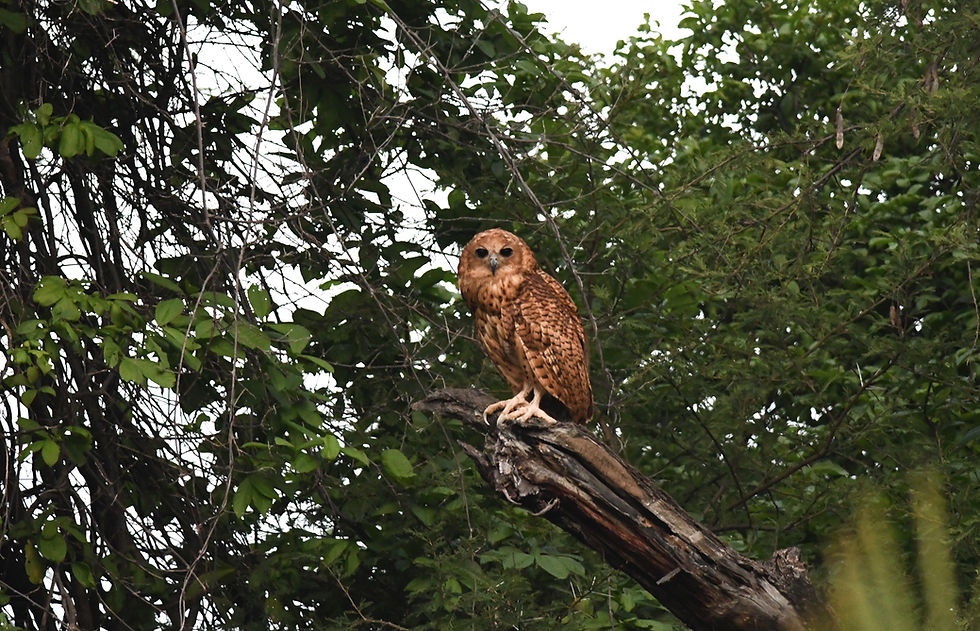
Arriving at the Pel's spot, we sat down and patiently waited in the hopes the finfoot would flash by. As focus waned, we wordlessly arose, ready for the star attraction. As we stretched our legs and moved less than 100 meters from the river's edge, we caught sight of an enormous form fleeing the canopy, and we knew we had flushed the owl once again. Working slightly upriver with more light and patience than the night before, we finally caught sight of it perched on an enormous limb by the banks of the river, only partially obscured by the foliage. Massive in form with formidable talons, the Pel's Fishing Owl was wholly captivating. I doubt it has few rivals in the hearts of birders that have been lucky enough to observe one. As we watched, the owl took off. Following suit, we continued upriver in hopes of another view. Sure enough, there it was, completely in the open on an even bigger limb overhanging the water. Cameras and scope drawn, we would not be pried away from the crystal clear views of this king of owls. I don't recall what, or even if, words were exchanged, but it was only the unmistakeable ruckus of some very close, and very hidden elephants that stirred us back to reality. Leaping into the Nissan, we pulled a U-turn out of there as fast as we could. One does not want to be surprised by elephants at point blank range!
Evening was setting in as we passed the finfoot crossing. Peering into the semi-darkness with our bins, we hoped for a successful hail mary at day's end. No finfoot, but to our surprise, a strange bird flew in and landed on the smallest of sandbars. In the dark it was hard to make out, but it turned into a White-backed Night Heron, a bird well east of where it is expected. With that, we knew it was time to dutifully return to camp lest we run afoul of the park rules, though I was almost as eager for the night drive as I was for the day's birding. With wheels spinning, the headlights flashed across the unmistakable form of a Leopard, body primed for the hunt and fixated on some unseen prey in the roadside acacias. Momentarily disturbed, it did not linger, and left me literally catching my breathe as I babbled incoherently with unbridled excitement at what we had just witnessed. To close out the evening, I spotlighted a Verreaux's Eagle-Owl atop a tree. Just wow! What a day!
Day 22 - April 21
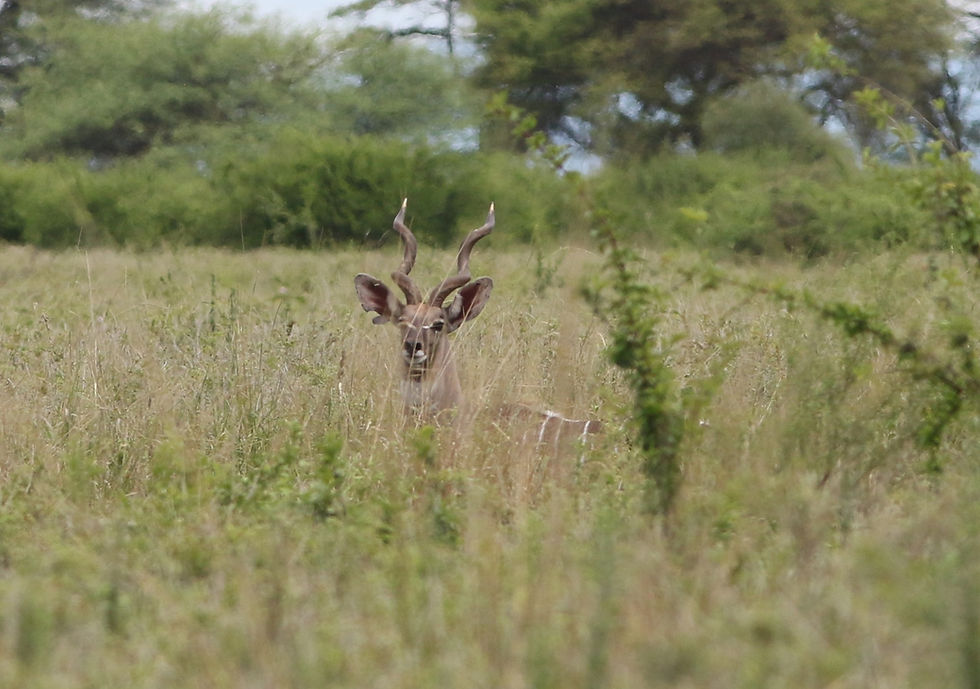
Content to get an organic start in the morning, not much was planned except to make it back to Nairobi in one piece. This was our last birding day of the whole trip, and a pinch of melancholy was setting in. To offset this, we tempted the pool once again with great success. Camp packed and all purchased fruits consumed, the road out offered me one last Safari opportunity. As the grass and shrubs whistled by, Chestnut Weavers and Red-billed Quelea roved about. Just before the gate we spotted one more mammal to make my heart soar, a Lesser Kudu. If you had asked me from the ages of 6-13 what my favorite animal was, I would have answered 'Kudu'.
With that, Meru was done, and while Adrian and Jack talked birds in the back seat, Tim and I rested our bird brains. I did catch snippets of their convo and drew the conclusion that Nyeri Hill, part of Jack's local birding patch, seemingly has 'all' the birds. On the way to Nairobi, two quick forest stops courtesy of Adrian's knowledge gave me Moustached Tinkerbird and White-eared Barbet, my last lifers of the trip. After some coffees and lunch, we dropped Adrian off somewhere unremembered, and Jack in Nyeri.

Back down to two, we were faced with one last ruffle. Dark, and on the home stretch into town, we ran out of gas. I maintain it is the sole purview of the driver to keep an eye on the gas gauge, but after 22 days of hardcore birding, and countless hard Kilometers driven, shit happens. As Tim flagged down a fella on a motobike and they hightailed it to the nearest town with a jerrycan in tow, I sat in the dark on the side of the highway. I sat 'guarding' the guy's furniture that he had so expertly strapped to his bike and graciously dismantled to make space for Tim. If any passing drivers saw a random white dude sitting there in the dark, they surely would wonder, but seeing as I am not privy to their inner thoughts, we will never know what they concluded from the situation. With a full jerrican, they arrived back and monetary thanks was given.
Back on the road, the last kilometers flew by. In the end Tim, myself, and the Nissan arrived at last after one wild, whacky, thrilling, and fun birding adventure!

Epilogue
Originally, it looked like we had ended the trip a few species short of 600. After checking the eBird lists and realizing I had forgotten a few birds including the one and only Sokoke Pipit, we ended with 601 species! Here is the eBird trip report https://ebird.org/tripreport/215953, and if anyone wants more specifics on birding Kenya, I am happy to dispense with information.
In the end, the car repairs were reasonable given how cheap labour costs are in Kenya, but it should be noted that in addition to the mangled door, one of the front shocks was holding on by a thread, and there was other damage to the frame. We can only assume this occurred when we smoked that huge hidden rock while tempting the overgrown track in the Mara. All's well that ends well as they say.
Our Violet-breasted Sunbird at the ranger camp at the Tana River primate reserve turned out to be a Tsavo Sunbird. A great bird in its own right, but not of the same caliber as the Violet-breasted.
The flooding in the Mara got really bad after we left, and several camps in the region had pretty harrowing night time escapes, though I think loss of life was avoided.
When we got back to Tim's school, the whole campus was flooded, and they ended up postponing classes. We could have potentially birded a day more before my flight, but I was done.


Nailed it dude.